Love Livin' in Penguin TAS 7316
Prefer Homeowner Blog in Google Search
Love Livin' in Penguin TAS 7316
Penguin is a small north-west Tasmanian seaside town where Bass Strait, a working hinterland and the Dial Range meet. The town’s identity is unusually clear: little penguins, a giant foreshore mascot, an undercover Sunday market and a heritage trail all sit within a compact coastal setting. For prospective residents, that mix means an everyday address with real access to nature, while larger regional services remain within reach by road or bus.
Setting and character
Penguin sits on the Bass Strait coast, about 18 kilometres east of Burnie and 131 kilometres north-west of Launceston by road, according to Tourism Tasmania. 1 The Old Bass Highway provides a scenic coastal approach, with ocean views, beaches and picnic places along the route. 1 Inland, farmland rises toward the Dial Range, giving the town a distinct coast-to-country outlook rather than a purely beachside feel.
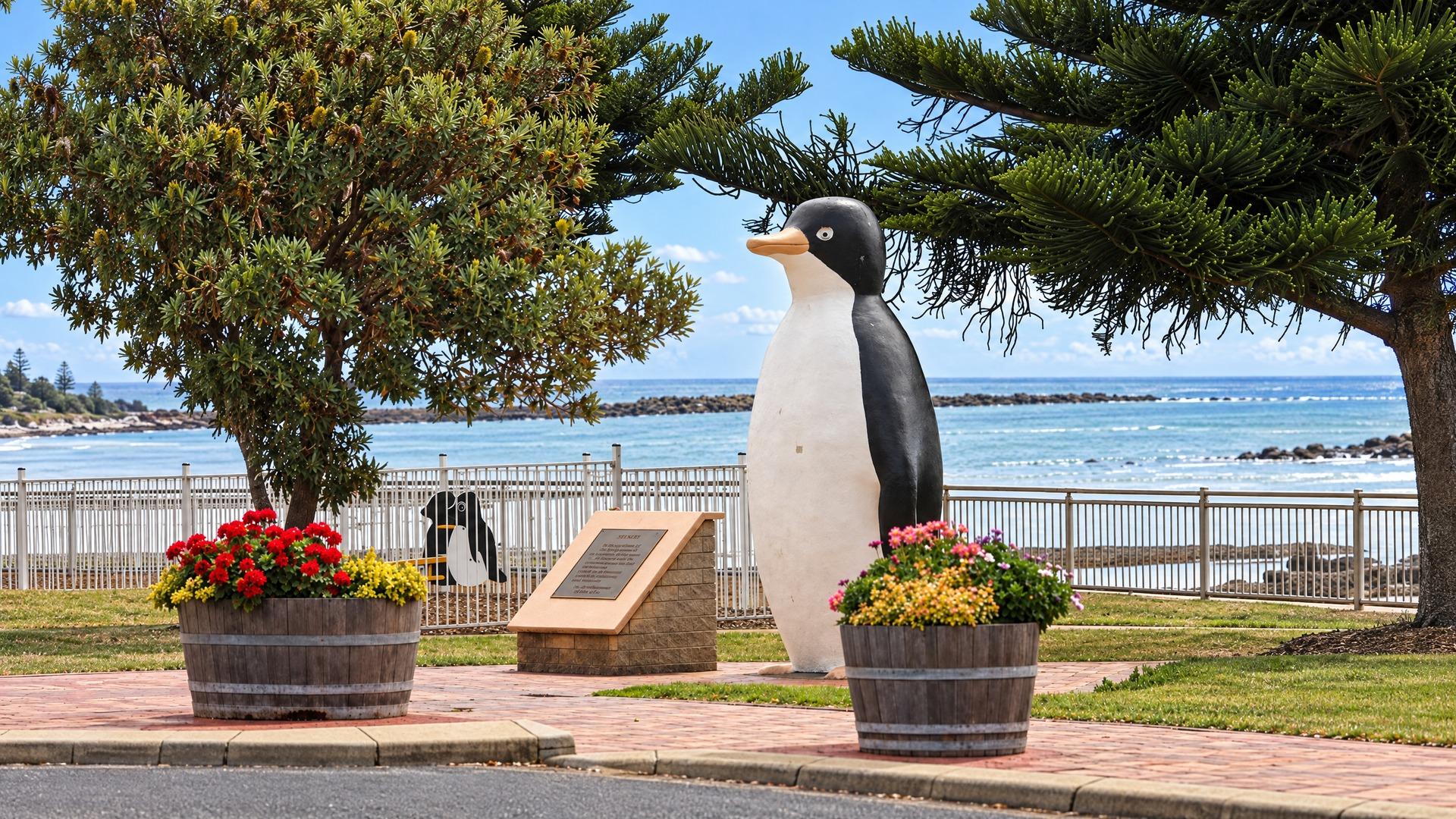
The name is more than branding: Tourism Tasmania says it comes from a nearby little-penguin rookery. Penguins return from the sea at night, and the town’s 3-metre Big Penguin, penguin-themed street furniture and signage make the local symbol part of the public realm. 1 That wildlife connection comes with responsibilities. Visitors should keep at least 3 metres from burrows, avoid flash and loud noise, keep dogs away and never catch or harass birds. 1
Penguin’s character is also visible in its built history. The official Penguin Heritage Trail links 26 historic sites, including the 1903 Uniting Church and the heritage-listed Penguin General Cemetery. 1 The result is a town that rewards walking and looking closely: community gardens, older civic buildings and foreshore landmarks sit alongside cafés, small businesses and working roads.
Daily life and essential services
The practical centre is around Main Road and the foreshore, with shopping and food options supplemented by nearby Ulverstone and Burnie. The Penguin Visitor Information Centre at 78 Main Road provides local and statewide travel information, brochures and souvenirs; it also lists a public toilet, car parking and RV parking. 2 For residents, it is useful for orientating visiting family and checking local information.
Central Coast Council operates a Penguin Service Centre at 78 Main Road, open 9:00 am–3:30 pm Monday to Friday, excluding public holidays. 3 Council directs sewerage, water-supply and wastewater emergencies to TasWater on 136 992, while roads, stormwater, parks, recreation grounds and animal-control emergencies have a separate after-hours number. 3 Those details are worth saving when moving in, particularly where drainage and weather can matter.
Families can access the Tasmanian Department of Health’s Child Health and Parenting Service at 19 Ironcliffe Road. The service provides free child-health and development assessments for children aged 0–5, with a statewide contact number of 1300 064 544. 4 More complex medical needs are handled through the region’s broader health network, so buyers should confirm their preferred general practice, pharmacy and hospital arrangements rather than assume every service is in town.
Community recreation is well represented. Council lists Zvoni Gornik Lions Park Penguin as providing a playground, barbecues, picnic space and toilets, while Johnsons Beach Reserve and Hiscutt Park add further open-space options. 5 Hiscutt Park is particularly recognisable for its Dutch windmill, lake, flower garden and playground. 6
Recreation and attractions
The foreshore is the natural starting point for a morning walk, a picnic or an easy introduction to the town. The Big Penguin stands on the Esplanade, while the Sunday Penguin Market, at the corner of King Edward and Arnold streets, is listed by Central Coast tourism as an undercover market with more than 70 stalls, operating 9:00 am–3:00 pm. 6 Check opening details before planning around it, as events and seasonal arrangements can change.
For active weekends, Penguin Mountain Bike Park is about 2 kilometres from town and has more than 6 kilometres of cross-country trails plus jumps, wall rides and a skills area, according to the local tourism listing. 6 The broader Dial Range offers a natural bushwalking experience. Parks and Wildlife Service describes multiple peaks, varied geology, mining remnants and tracks through stringybark, peppermint, swamp-gum and wet-sclerophyll vegetation. 7
There are options for different abilities: Ferndene’s all-access boardwalk follows McBrides Creek to a viewing platform; Thorsbys Tunnel reveals evidence of the district’s mining history; Mount Gnomon Lookout is a short, steep 2-kilometre return walk; and Mount Montgomery is listed as a 5-kilometre, Grade 3, two-hour return walk with views toward Bass Strait, Penguin and Ulverstone. 7 Multi-use tracks can include mountain bikes, and Parks and Wildlife advises avoiding driving in reserves at night because of wildlife on the roads. 7
Travel and access
A car remains useful for the hinterland, larger shopping trips, appointments and exploring the north-west. Public transport is a genuine option for some regional journeys, however. Transport Tasmania’s Route 708 North West Express links Devonport, Ulverstone, Penguin West and Burnie. The published timetable shows weekday services from Devonport through Penguin West to Burnie, with Saturday and Sunday/public-holiday services also listed. 8 The stop shown for Penguin is at Preservation Drive/Main Road, so check the current timetable and walking connection from any particular home before relying on it for commuting.
Tourism Tasmania places Penguin roughly a 15-minute drive from Burnie and describes Launceston as about 90 minutes away, although actual times vary with traffic, weather and the chosen route. 1 Devonport is an important regional connection for services and travel. In winter or during severe weather, allow extra time and check road and bus conditions before setting out.
Practical property and buying considerations
The most important distinction in Penguin is not a price bracket but a site: flat coastal streets, sloping foothills and rural-edge properties can have very different maintenance, access and planning implications. Walk the block in wet weather, inspect drainage and retaining walls, ask about salt exposure, and confirm how stormwater, wastewater and road access are managed. Treat sea views as a feature to verify from the actual dwelling, not from an online listing.
Before committing, use Central Coast Council’s planning information and obtain independent legal, building and pest advice. Council explains that a planning permit is a legal document authorising a particular use or development, while building approvals are a separate process. 9 Council may require reports addressing land hazards such as bushfire, and applications require items including a Certificate of Title, site plan, access details and setbacks. 9 That makes it sensible to check zoning, overlays, permitted uses, past approvals and any proposed works before signing, especially for extensions, secondary dwellings, sheds, earthworks or a business from home.
Also investigate insurance availability and exclusions, coastal wind exposure, bushfire risk near the Dial Range, easements, heritage constraints and whether the property’s services are connected as expected. For a lifestyle move, test the practical routine: walk to the bus stop, shops and foreshore; drive the commute at peak times; and confirm mobile, internet and heating arrangements at the exact address. These checks are more useful than broad assumptions about the suburb.
Penguin suits people who want a recognisable town centre, a dramatic coast-to-range setting and a calendar shaped by local community life, while accepting that some specialist services and everyday trips extend beyond the postcode. Its appeal is grounded in things that can be visited, measured and enjoyed: a foreshore, a market, a heritage trail, public parks and a protected mountain landscape. Do the site-specific due diligence, and Penguin TAS 7316 can offer a thoughtful balance between small-town routine and north-west Tasmanian access.
References
More from Love Livin' series

Love Livin' in Bronte NSW 2024: Your Complete Suburb Guide
Bronte NSW 2024 offers exclusive beachside living with a family-friendly atmosphere, stunning ocean pool, and strong community spirit.

Love Livin' in Potts Point NSW 2011: Your Complete Suburb Guide
Potts Point NSW 2011 combines inner-city sophistication with bohemian charm, offering excellent dining and vibrant nightlife.

Love Livin' in Darlinghurst NSW 2010: Your Complete Suburb Guide
Darlinghurst NSW 2010 offers cultural and arts district with excellent amenity and lifestyle options.